 Hyperliquid
 fees change with trading volume, market settings, and execution
last updated
Hyperliquid fees depend on trading volume, the selected market, and whether an order adds or removes liquidity. Higher qualifying volume can lower the applicable trading rate. A useful cost comparison also includes execution prices, eligible discounts, and any additional builder charge. Perpetual positions introduce funding payments while they remain open. Compare the same intended trade under each execution choice, then reconcile actual charges against its fills and the resulting account balance.
Spot trades and perpetual positions incur different costs
The selected market determines which charges apply and what remains in the account after execution. Spot and perpetual trading use separate fee schedules.
Spot execution and asset balances
A spot trade exchanges the selected assets. Its immediate cost includes the execution charge and the price obtained against available liquidity. If preparing the account requires another conversion, that conversion adds its own execution cost. An already funded trading balance avoids that extra operation. Keep the original transfer amount separate from the amount available after conversions and deductions.
Perpetual execution and continuing exposure
A perpetual trade changes a collateral-backed position. Opening and closing executions contribute trading costs, while funding payments affect a position open at the funding payment time. Funding can produce a payment or a receipt, depending on position direction and the applicable rate. It therefore belongs in the holding-cost calculation, with its sign preserved. A trading-fee discount does not reduce that separate payment.
Maker and taker describe the execution
A maker supplies resting liquidity, while a taker executes against liquidity already available in the order book. These roles explain the separate rate columns.
Immediate matching
A market order seeks immediate execution against available orders. A limit order can also remove liquidity when its price permits immediate matching. The word "limit" therefore does not establish maker treatment. Execution against several price levels can change the average fill price, even when the applicable fee rate stays unchanged.
Resting liquidity
Post-only instructions restrict an order to resting execution. They support a maker-only approach without promising a fill. Waiting also changes the comparison: the market can move while an order remains open. A cheaper execution rate has limited relevance when the intended trade never completes.
How does trading volume change the fee tier?
Hyperliquid assesses qualifying volume over a rolling 14-day window, with tier assessment at the end of each UTC day.
Spot and perpetual trading contribute to a shared volume tier. The base weighting counts spot volume twice, subject to applicable market adjustments.
Older trades eventually leave the window. Consequently, a tier can fall even without a new trade. A lifetime volume total cannot establish the applicable tier.
Additional turnover also incurs costs. Comparing prospective savings with the cost of generating extra volume avoids treating a lower tier as an automatic economic benefit.
Discounts and market settings modify the account rate
Eligible HYPE staking can reduce trading fees. Builder-deployed perpetual markets under HIP-3 can also apply deployer settings that change charges and qualifying volume. The applicable market configuration matters alongside the account tier.
Aligned quote asset versions require particular care. AQAv1 provides lower taker fees, larger maker rebates, and higher volume contribution when the aligned asset serves as a spot pair’s quote asset or as collateral for HIP-3 perpetuals. AQAv2 does not provide those benefits. An aligned designation alone therefore cannot establish a discount. The version and the market relationship must match the benefit.
An application can separately attach a builder fee to an order after the user authorizes its maximum. This charge compensates the application builder. It differs from a HIP-3 market deployer’s fee, so the two concepts should remain separate in an estimate.
Why can a lower fee produce a higher total cost?
A lower fee can coincide with a worse execution price, which increases the amount spent or reduces sale proceeds.
For a like-for-like comparison, hold the instrument, direction, and intended quantity constant. Compare the executable prices for that quantity, including the available depth. The spread separates the best buying and selling prices; deeper orders can execute at different prices. An indicative price at the top of the book does not describe every fill in a larger order.
Calculate each trading charge using its applicable execution basis and rate, then combine the actual fills. Compare funding over the same holding period when evaluating perpetual positions. If a cost estimate already measures execution against a chosen reference price, adding the same spread effect again would overstate the cost.
Comparing costs before committing an order
Consider a hypothetical comparison between immediate execution and a resting order for the same selected market and quantity. Assume the account already has the required balance or collateral. No trade occurs during preparation. You can revise or abandon the proposed order before submission. Submitting it authorizes matching; subsequent cancellation cannot reverse completed fills.
| Stage | Cost input | Observable evidence | Remaining control |
|---|---|---|---|
| Establish the account state | Available balance, collateral, and applicable account rates | Account records identify the starting state | Review without submitting an order |
| Compare execution choices | Same quantity, executable prices, and applicable charges | Order book and proposed order terms support the estimate | Revise or abandon either choice |
| Refresh before submission | Changed liquidity, account state, or fee settings | Updated inputs still support the selected terms | Withhold submission if the estimate no longer applies |
| Submit the chosen order | Authorized quantity, price condition, and builder charge if applicable | Order status distinguishes acceptance from execution | Matching may begin; cancellation only affects unfilled quantity |
| Reconcile executed costs | Fill prices, quantities, and recorded fees | Execution records agree with the resulting account state | Completed fills remain final |
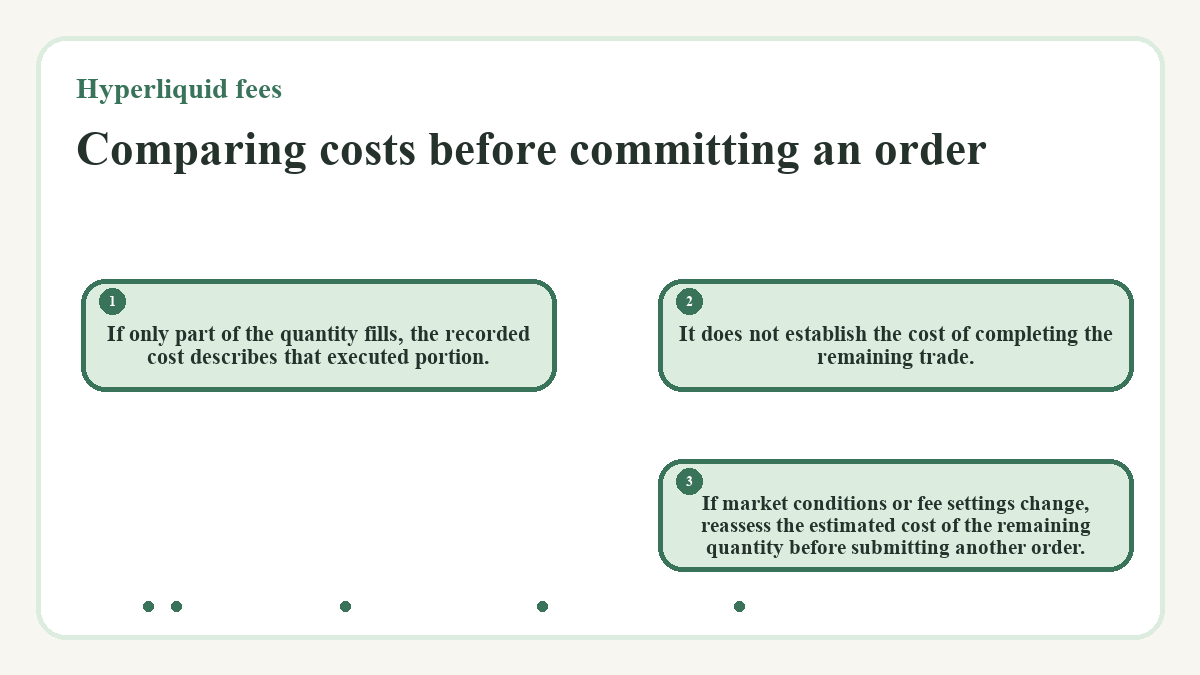
If only part of the quantity fills, the recorded cost describes that executed portion. It does not establish the cost of completing the remaining trade. If market conditions or fee settings change, reassess the estimated cost of the remaining quantity before submitting another order.
Account transfers and application gas add separate charges
Depositing or withdrawing funds can incur costs that depend on the transfer method and network. Those costs arise outside the ordinary trading-fee calculation. They matter when comparing a complete movement into and out of a trading account, especially when the trade itself uses funds that must first move elsewhere.
Ordinary HyperCore order book trading does not require a separate gas payment for each trade. HyperEVM application transactions use HYPE for gas. An application interaction can therefore have a different cost structure from a direct order book trade. Account for the operations actually required, without treating every interaction in the ecosystem as gas-free.
Which records establish the actual trading cost?
Fill records establish executed quantities, prices, and fees; account balances establish their effect alongside other account activity.
The account API exposes fee information through userFees and execution records through userFills. Preserve the recorded fee token and sign when totaling charges; a negative fee represents a rebate. Amounts denominated in different assets require an explicit valuation basis before they can form one monetary total.
Profit-and-loss displays can already incorporate fees. Adding charges again to a figure that includes them creates a second deduction. Deposits, withdrawals, funding, and position changes can also move an account balance, so the balance difference alone does not isolate execution costs.
The fee field in a fill record includes its builderFee component.
Treat the component as a breakdown of the total, rather than an additional amount to add to it.
Hyperliquid fees - your questions answered
Does a sub-account receive the master account’s referral discount?
Sub-accounts share the master account’s fee tier, but referral discounts do not apply to them. Shared tier treatment therefore does not establish an identical effective charge across accounts. A comparison between the master account and a sub-account needs to distinguish the volume tier from referral eligibility.
Can I revoke an application’s builder-fee approval?
You can revoke a builder-fee approval to stop that authorization from permitting future builder charges. The approval specifies a maximum for the particular builder, while individual orders can carry a builder fee within the authorized limit. Revocation does not refund charges from completed fills.
Are builder fees charged on both sides of spot trading?
Builder fees do not apply to spot purchases under the documented quote-asset collection rule. They can apply to spot sales and both directions of perpetual trading. This restriction concerns the additional builder charge; it does not remove the ordinary trading fee from a spot purchase.
Why might my referral discount stop applying?
Referral discounts have a qualifying-volume limit, so entering a code does not establish permanent eligibility. The account’s active referral-discount state determines whether the discount still applies. Vaults and sub-accounts also fall outside referral-discount eligibility, even when related account activity contributes to other fee calculations.
Is an API fee-rate decimal the same as a displayed percentage?
An API rate expressed as a decimal fraction needs multiplication by 100 to express it as a percentage. Using a percentage directly as a decimal multiplier would overstate the calculated charge. Preserve the representation of the field being used, and distinguish a rate from the monetary fee recorded for a fill.